

Week 2: Creating a microeconomic model for Attention
Project: A Thing A Week | Week 2

This post is under the A thing A week project where I try to do a new thing every week or so.
My first brush with microeconomics was in the first year of MBA.
Then there were some encounters with it in the days of consulting, which included grappling with conceptual curves.
And then there was a period of very little interaction, except for back of the mind principles used in business every now and again.
This week, I reacquainted myself with the discipline under this project and I remembered what an intellectual delight the field is.
The Topic
I end up wasting time, even when I don’t really want to. Often, I pick up my phone to scroll my feed for a break and then the next thing I know, 45 minutes have gone by. Why does this happen? I think of myself as a rational person ( though some say it is debatable), so I should be able to place value on my attention. I should be able to allocate attention better.
I wondered if I could apply microeconomics to this problem - after all platforms demand my attention and I supply it. This became the basis for this week’s project.
If you want to skip and look at the outcome and thesis, then read here:
The Process
I started this project on Nov 14, and ended it by Nov 21. It took a week to do the project, and one day to write the paper.
The first two days were spent in reading about attention and micro-economics. Here use of Chat GPT was extremely helpful in focusing my reading. Also I used it as a ready tutor to explain new topics to me in a fairly rapid manner.
In parallel, I also spent time in conceptualising and sketching out several ideas on paper. (Pro Tip: Using A3 sheets for brainstorming is so much better for new ideas.)
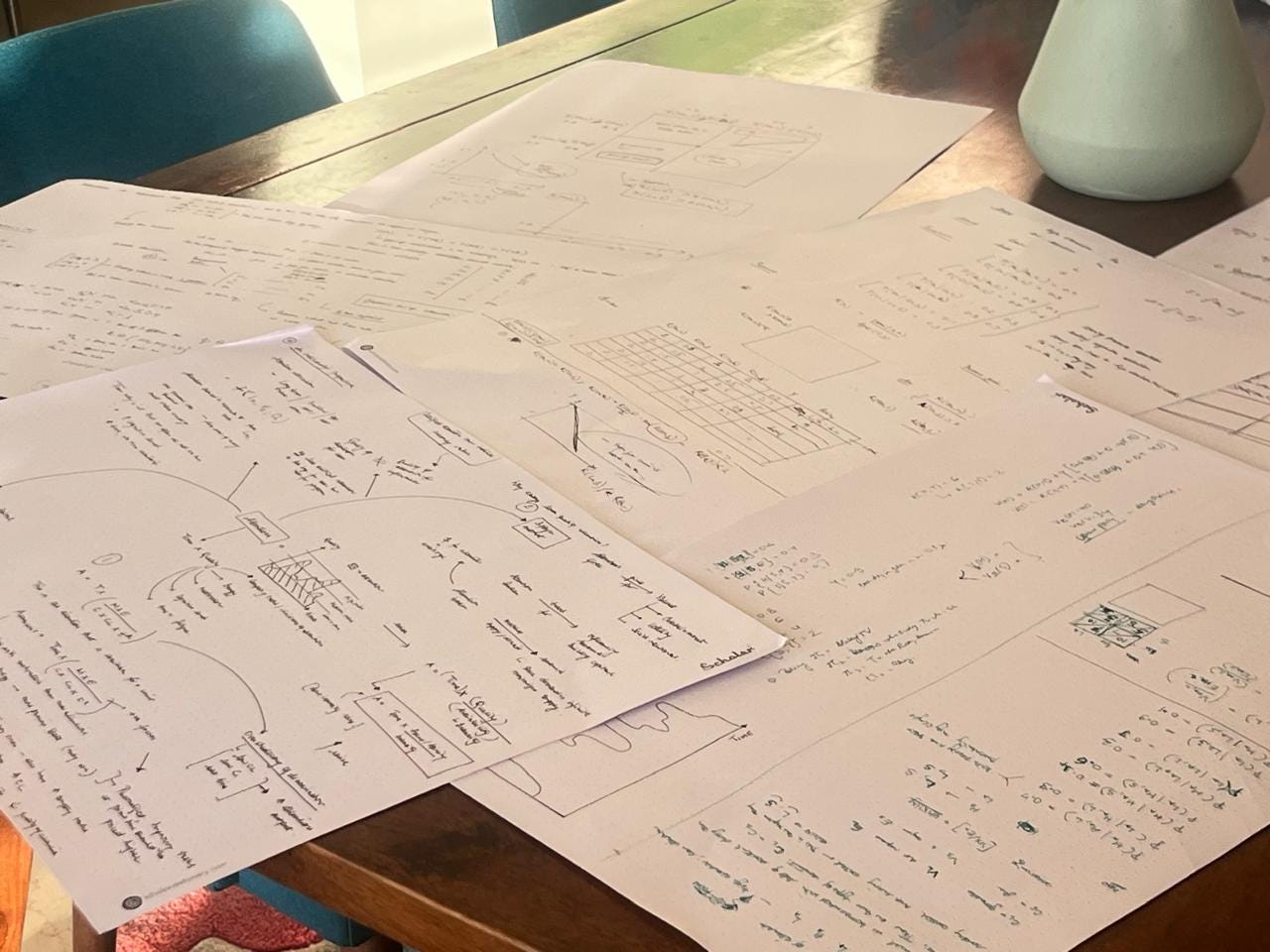
By day 3, I had an idea of the construct I wanted to use, but it took me a couple of more days to grasp the modelling and mathematics behind it.
Even after that there was a problem. I found doing actual computation was difficult and intensive, since I was trying many scenarios. So I took help of vibe coding on cursor to create a small python model to solve for Markov Decision Process (more on this in the outcome article)
Finally, I ran scenarios and considered the implication, which then culminated in an article.
The Learnings
Here is what I learned from this experience:
Microeconomics thinking is incentive thinking: As I sifted through reading materials and my own thoughts on the topic, I was reminded that thinking about microeconomics is thinking through behaviour driven by incentives. I came across this quote by Steven Landsburg, which I loved:
“Most of economics can be summarized in four words: ‘People respond to incentives.’ The rest is commentary”
I had started thinking about supply demand curves of attention but was not heading anywhere. But when I started with the incentive question, is when I found a way to frame it better.
AI makes thinking faster: This might be the most Captain Obvious statement, but let me say it anyway. I used AI in two ways: (a) To learn something about something in a new field on a new topic (b) To create programs to solve some maths, when I do not really know programming. Both these are augmentations and not just replacement of my labour. Both these made my thinking faster.
Crude models of reality can be powerful: When I started this problem, there was not a lot of data, nor did I know how to collect it in a short time. So I had to rely on assumption which can only lead to crude models of reality. These may not lead to accurate answers, but can generate powerful insights. I find in our workspaces this is an under-utilized approach.
Joy of working without an end use: This was done not for my work, nor for any potential business, nor for any particular end use that I can think of. Yet, it felt very fulfilling. There was ideation, studying, maths, writing - it was as if I was back in school. Except I wasn’t. I was just working on something interesting, with no consideration for its use. There is great joy in that.
The Outcome
Outcome of this week was a thought paper that captures a model for attention and its use to understand some behaviours related to it. I have published the paper here:
I would love to go deeper on this. So if you go through it, let me know your thoughts, criticism, suggestions etc. Also if you would like to collaborate to develop this, I would love to talk.
Cheers,
Abhishek
P.S. - Still inviting suggestion for what next projects to pick in A Thing A Week.